Edited Book

  • Kashihara, A., Jiang, B., Rodrigo, M.M., & Sugay, J. O. (Eds). (2024). 32nd International Conference on Computers in Education Conference Proceedings Volume I.  November 25-29, 2024. Manila, Philippines. Asia-Pacific Society for Computers in Education.
  • Kashihara, A., Jiang, B., Rodrigo, M.M., & Sugay, J. O. (Eds). (2024). 32nd International Conference on Computers in Education Conference Proceedings Volume II.  November 25-29, 2024. Manila, Philippines. Asia-Pacific Society for Computers in Education.
  • Rodrigo, M. M., Matsuda, N., Cristea, A. I., & Dimitrova, V. (Eds.). (2022). Artificial Intelligence in Education. Posters and Late Breaking Results, Workshops and Tutorials, Industry and Innovation Tracks, Practitioners’ and Doctoral Consortium: 23rd International Conference, AIED 2022, Durham, UK, July 27–31, 2022, Proceedings, Part II (Vol. 13356). Springer Nature.
  • Rodrigo, M. M., Matsuda, N., Cristea, A. I., & Dimitrova, V. (Eds.). (2022). Artificial Intelligence in Education: 23rd International Conference, AIED 2022, Durham, UK, July 27–31, 2022, Proceedings, Part I (Vol. 13355). Springer Nature.
  • Rodrigo, M. M. T., Iyer, S., & Mitrovic, A. (2021). 29th International Conference on Computers in Education Conference Proceedings Volume I. Taiwan: Asia-Pacific Society for Computers in Education.
  • Rodrigo, M. M. T., Iyer, S., & Mitrovic, A. (2021). 29th International Conference on Computers in Education Conference Proceedings Volume II. Taiwan: Asia-Pacific Society for Computers in Education.
  • Mitsuhara, H., Goda, Y., Ohashi, Y., Rodrigo, M. M. T., Shen, J., Venkatarayalu, N., … & Lei, C. U. Proceedings of 2020 IEEE International Conference on Teaching, Assessment, and Learning for Engineering (TALE).
  • So, H-J, Rodrigo, M. M., Mason, J., & Mitrovic, A. (2020). 28th International Conference on Computers in Education Volume II. Taiwan: Asia-Pacific Society for Computers in Education.
  • So, H-J, Rodrigo, M. M., Mason, J., & Mitrovic, A. (2020). 28th International Conference on Computers in Education Volume I. Taiwan: : Asia-Pacific Society
  • Yang, J.C., Chang, M., Wong, L-H., & Rodrigo, M. M. T. (2018).  26th International Conference on Computers in Education: Main Conference Proceedings. Taiwan: Asia-Pacific Society for Computers in Education.
  • Wu, Y-T, Srisawadi, N., Banawan, M., Yang, J.C., Chang, M., Wong, L-H., & Rodrigo, M. M. T. (2018).  26th International Conference on Computers in Education: Workshop Proceedings. Taiwan: Asia-Pacific Society for Computers in Education.
  • Ogata, H., Song, Y, Yang, J.C., Chang, M., Wong, L-H., & Rodrigo, M. M. T. (2018).  26th International Conference on Computers in Education: Extended Summary Proceedings. Taiwan: Asia-Pacific Society for Computers in Education.
  • Ding, J., Song, Y., Coronel, A. D., Amalathas, S., Yang, J.C., Chang, M., Wong, L-H., & Rodrigo, M. M. T. (2018).  26th International Conference on Computers in Education: Work-in-Progress Poster Proceedings. Taiwan: Asia-Pacific Society for Computers in Education.
  • Murthy, S., Ogata, H., Chen, W., Yang, J.C., Chang, M., Wong, L-H., & Rodrigo, M. M. T. (2018).  26th International Conference on Computers in Education: Doctoral Student Consortium Proceedings. Taiwan: Asia-Pacific Society for Computers in Education.
  • So, H-Y., Chang, M., Jong, M., Yang, J.C., Wong, L-H., & Rodrigo, M. M. T. (2018).  26th International Conference on Computers in Education: Early Career Workshop Proceedings. Taiwan: Asia-Pacific Society for Computers in Education.
  • Andre, E., Baker, R., Hu, X., Rodrigo, M. M. T., and Du Boulay, B. (Eds). (2017). Artificial Intelligence in Education. Lecture Notes in Artificial Intelligence 10331. Gemany: Springer.
Posted in Publications | Leave a comment

Building Higher Education’s Capacity to Conduct Eye-tracking Research using the Analysis of Novice Programmer Tracing and Debugging Skills as a Proof of Concept. Loyola Schools

Posted in Past Research Grants | Leave a comment

ALLS Presents at EDM and AIED 2017

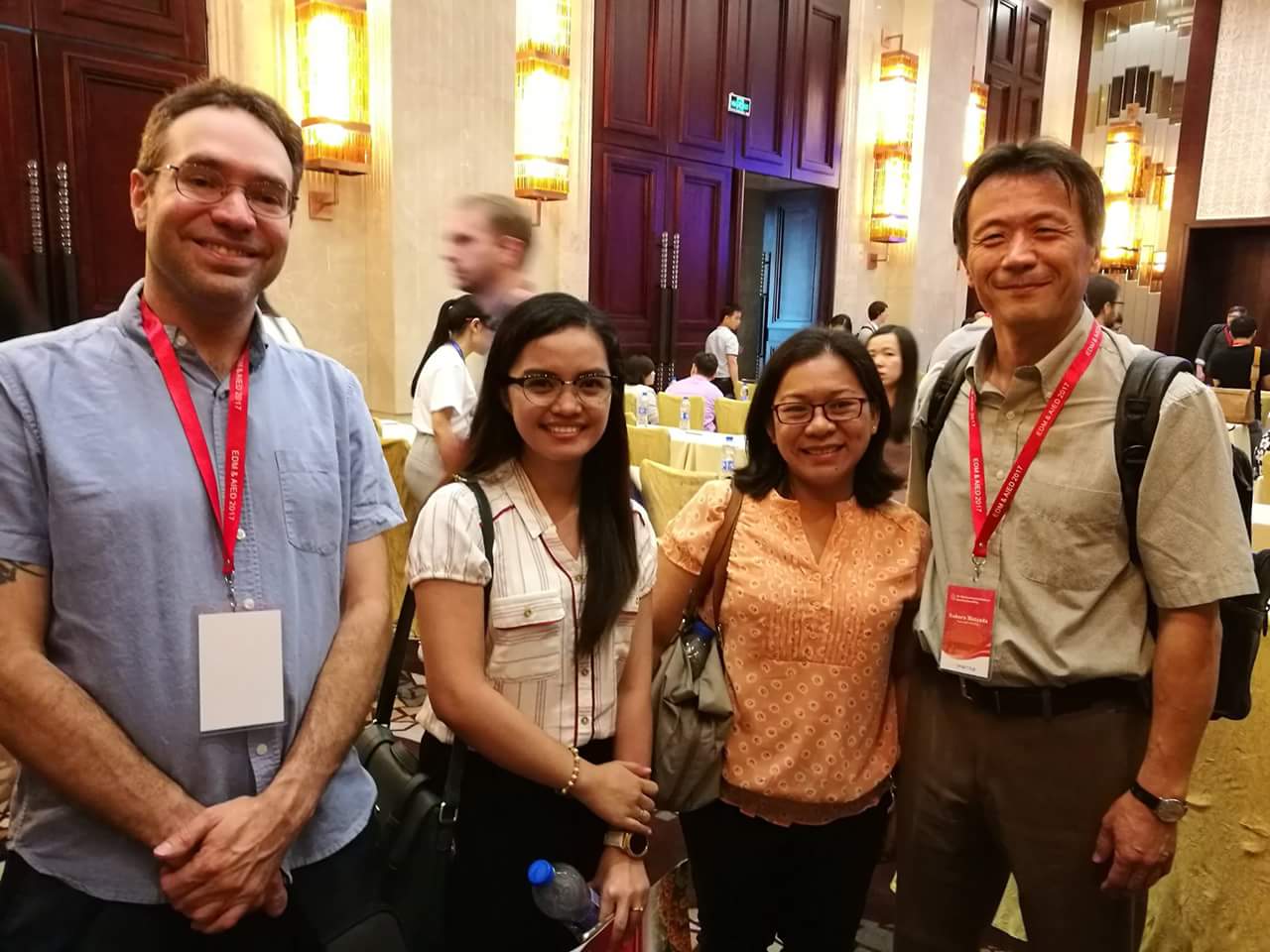
The 10th International Conference on Computers on Educational Data Mining and the 18th International Conference on Artificial Intelligence in Education were held last June 25 to 28 and June 29 to July 1 in Wuhan, China. In attendance were six members of the Ateneo Laboratory for the Learning Sciences: Dr. Ma. Mercedes Rodrigo, May Marie P. Talandron, Cristina E. Dumdumaya, Maureen Mamilic-Villamor, Cristina Enriquez and Yancy Paredes.

The following conference papers and poster papers were accepted into the conference and presented that week:1. Characterizing Collaboration in the Pair Program Tracing and Debugging

  1. Characterizing Collaboration in the Pair Program Tracing and Debugging
    Eye-Tracking Experiment by Maureen Villamor and Dr. Rodrigo — short paper,
    EDM
  2. Assessing the Collaboration Quality in the Pair Program Tracing and
    Debugging Eye-Tracking Experiment by Maureen Villamor, Yancy Vance Paredes, Japeth Duane Samaco, Joanna Feliz Cortez, Joshua Martinez, and Ma. Mercedes Rodrigo – poster, AIED
  3. Modeling the Incubation Effect among Students Playing an Educational Game
    for Physics by May Marie P. Talandron, Ma. Mercedes Rodrigo, and Joseph Beck
    – full paper, AIED
  4. Regional Cultural Differences in How Students Customize Their Avatars in
    Technology-Enhanced Learning by Cristina E. Dumadaya, Evelyn Yarzebinski,
    Ma. Mercedes T. Rodrigo, Noboru Matsuda, and Amy Ogan – poster, AIED
  5. Proficiency and Preference Using Local Language with a Teachable Agent
    by Cristina E. Dumadaya, Amy Ogan, Evelyn Yarzebinski, Roberto De Roock, Ma.
    Mercedes Rodrigo, and Michelle Banawan – poster, AIED
  6. Constraint-Based Modelling as a Tutoring Framework for Japanese Honorifics by Zachary Chung, Takehito Utsuro, and Ma. Mercedes Rodrigo – poster, AIED


Posted in News & Events, Uncategorized | Leave a comment

ALL Lecture Series

Monday, 10 July 2017, 9:00 to 4:00
Ateneo de Manila University (Exact room TBA)
ADMISSION IS FREE

Deep Learning with Educational Data
Joseph Beck, Ph.D.

This whole-day lecture focuses on applications of deep learning for educational data. Deep learning is a machine learning approach using neural networks with multiple levels of representational transformation (i.e., hidden layers). Deep learning has been used in a variety of domains over the past five years with impressive results. Recently, it has been used for educational data sets with mixed results when compared to traditional modeling methodologies.

In this lecture, Dr. Beck will provide an introduction to machine learning followed quickly by a discussion of deep learning. He will discuss applications as well as current work.

Joseph Beck, assistant professor of Computer Science, has been at Worcester Polytechnic Institute since 2007. His research focuses on educational data mining, a new discipline that develops techniques for analyzing large educational data sets to make discoveries that will improve teaching and learning. His work centers on estimating how computer tutors impact learning. He established the first workshop in the field and in 2008 was program co-chair of the first International Conference on Educational Data Mining. He holds a BS in mathematics, computer science, and cognitive science from Carnegie Mellon University, and a PhD in computer science from the University of Massachusetts, Amherst.

To register, please sign up here.

Posted in News & Events, Uncategorized | Leave a comment

Dr Gloria Washington on empathetic fitness trackers

Dr. Gloria Washington is an Assistant Professor at Howard University in the Computer Science Department. At Howard, she runs the Affective Biometrics Lab and performs research with her students on affective computing, biometrics, and computer science education. Her research is supported by the Department of Homeland Security, Leidos, and the TIDES Foundation. Before coming to Howard University she was an Intelligence Community Postdoctoral Research Fellow in the Department of Computing Science at Clemson University. She performed research on identifying individuals based solely from pictures of their ears. Dr. Washington has more than fifteen years in Government service and has presented on her research throughout industry. Ms. Washington holds M.S. and Ph.D. in Computer Science from The George Washington University, and a B.S. in Computer Information Systems from Lincoln University of Missouri.

Dr. Washington’s talk had highlighted that the incidence of children with chronic disease is growing in the U.S. and these children have special educational needs that relate to the way they learn how to care for themselves. Children with chronic disease learn positive health behaviors taught through self-management education taught by patient advocates, nurses, and their families. Unfortunately, this education usually begins around age 10 or 12; leading some to develop unhealthy habits and lack self-efficacy in improving their health. Fitness trackers were first created to help adults keep abreast of their fitness goals. However, these devices are slowly being introduced to children. There are no health and wellness technologies that are designed for children and exploit human physiological information to interpret and empathize with a child’s mental and/or physical health. Additionally, social cognitive models/theories were developed to help educational professionals identify the factors that influence how a person learns positive and negative health behaviors. These models include factors related to ethnicity, age, and socioeconomic status. Although these factors have proved significant in helping to design educational interventions for health psychologists; these theories have not been adapted for creation of educational materials relevant to children with chronic disease. There exists an opportunity for a new genre of fitness trackers that empathizes with the user, teaches positive health behaviors, contributes to a child’s self-efficacy and emphasizes the scientific underpinnings of a disease. This tool should also allow children the ability to teach themselves, their peers, and their caregivers through show and tell, positive reinforcement, and fun game-based activities. This talk focuses on introduction of a new empathetic fitness tracker that is used for instructional teaching of young children with chronic disease.

Posted in News & Events, Uncategorized | Leave a comment