ALLS Lecture Series, 7 November 2016

The ALLS Lecture Series
Monday, 7 November 2016, 3:00 to 4:30, Faura 206
ADMISSION IS FREE

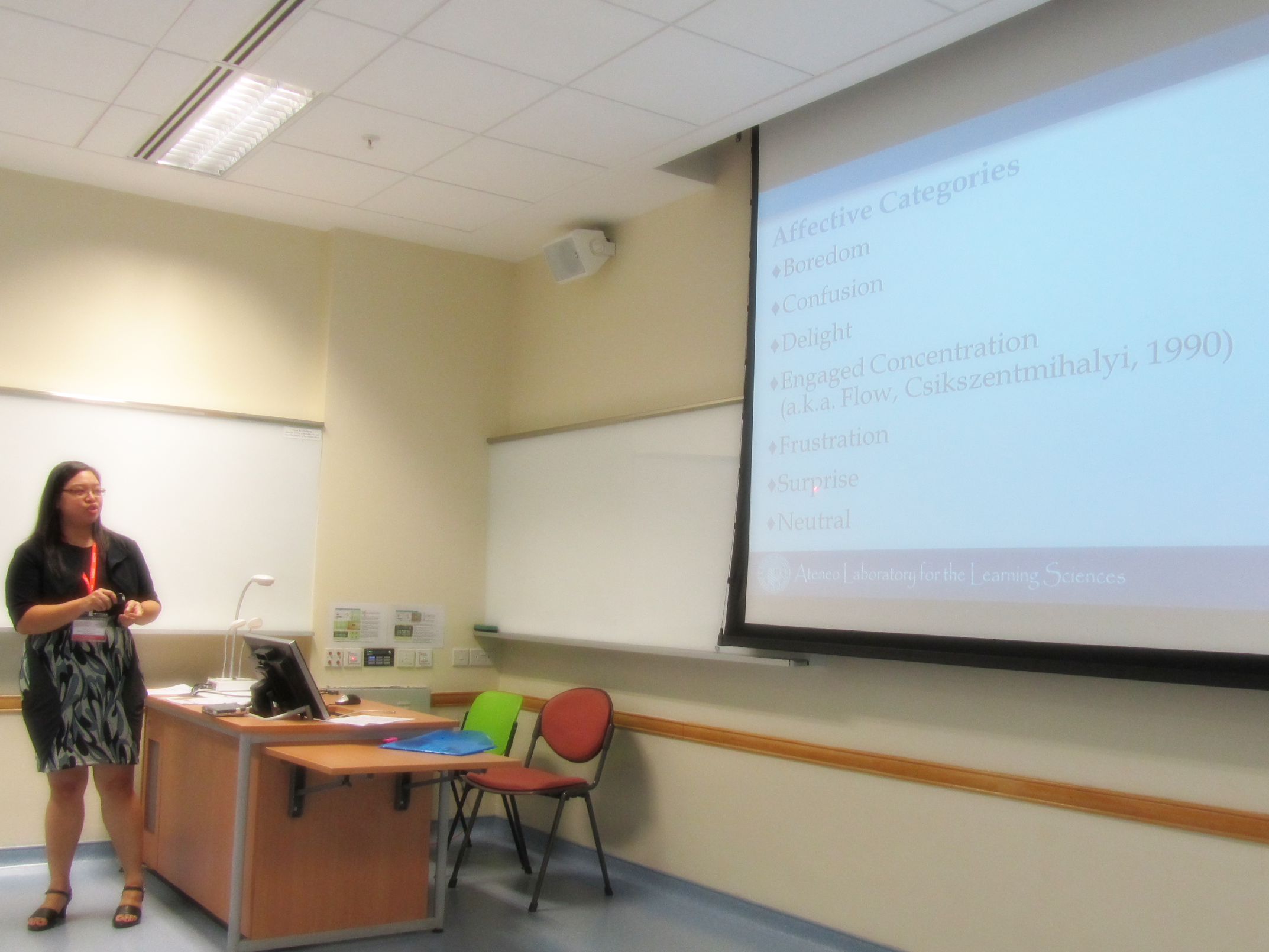
The talks presented during this lecture series represent current research of the Ateneo Laboratory for the Learning Sciences. The November 7 talks will feature brief presentations from PhD Computer Science students who are about to defend their proposals.

Detecting Student Carefulness In An Educational Game For Physics
Michelle Banawan
The creators of the educational game Physics Playground (formerly known as Newton’s Playground) hypothesized that student carefulness could be quantified and identified in-game indicators of carefulness using various behaviors and actions. Carefulness, as defined by the American Heritage Dictionary, means giving close or cautious attention, being thorough and painstaking in action or execution, or being alert, attentive, heedful, or mindful. A careful student is most likely to avoid trivial and/or careless errors. Students who have high self-discipline have been found to be more careful and avoid careless mistakes which can improve student performance. Moreover, carefulness has been found to be a non-cognitive determinant of student performance within an Intelligent Tutoring System (ITS) such that when students are more careful with their tasks, they make fewer mistakes and hence, better educational effectiveness is achieved as students no longer have to receive materials that they already mastered, most especially true for computer-based learning environments. The principal objective of this work is to create a detector for carefulness among students working on Physics Playground. The work begins with the establishment of a baseline quantitative carefulness model based on theoretical models of carefulness as published, but as of yet unvalidated, by the program’s lead researchers and then expands the detector to include other factors that social science theories link with carefulness. This work will provide empirical validation, using the educational data mining framework, to the student carefulness construct to be able to refine and extend it accordingly.

Intelligent Learning System for Automata (ILSA) and Learners’ Achievement Goal Orientation
Cesar Alipiz Tecson
Studying automata theory exposes the students to the theoretical foundation of Computer Science where they learn abstraction, generalization, and reasoning. However, teaching and learning automata is challenging because of the involved abstract notions and mathematical background. It is often regarded to be more affiliated with mathematics than with Computer Science. Many students experience difficulty in understanding the computability concepts. Yet, Computer Science programs everywhere require a course on automata theory and formal languages. . Hence, recent advances in teaching the course focus on the development of different pedagogical tools that can be used to facilitate the learning of automata theory and formal languages. Developments of tutoring systems for automata, like simulators, are continuously advancing. Fundamental efforts on features of automata simulators, based on the open literature, are focused on the following: visual creation, animation, conversion (transformation), interaction, logs generation, and saving and exporting facility. They do not support customization based on learners’ performance in the tutor environment, like provision of individualized learning path and feedback. While these existing tutors facilitate teaching and understanding of the concepts, they do not focus on identifying whether learning is achieved. Another factor that mediates student achievement is goal orientation. This theory suggests that students’ behavior and response to the learning environment are guided by goals. Some students are performance-oriented while others are mastery-oriented. These personal goals interact with the learning environment, sometimes referred to as classroom goals. How these classroom goals align with students’ individual goals can have an effect on both a student’s achievement and learning experience. Hence, the first goal of this study is to augment the capabilities of an automata simulator to characterize Intelligent Tutoring System (ITS) that is driven by a learner model to support individualized learning path, feedback, and support. The second goal of this work is to include features in the ITS that are intended to cater to the different achievement goal orientations of learners. The last goal would be to determine relationships between and among learners’ in-tutor behavior, their goal orientations, and learning.

To register, click here.

Posted in News & Events, Uncategorized | Leave a comment

ALLS Presents in ACLE 2016: Mixed Reality

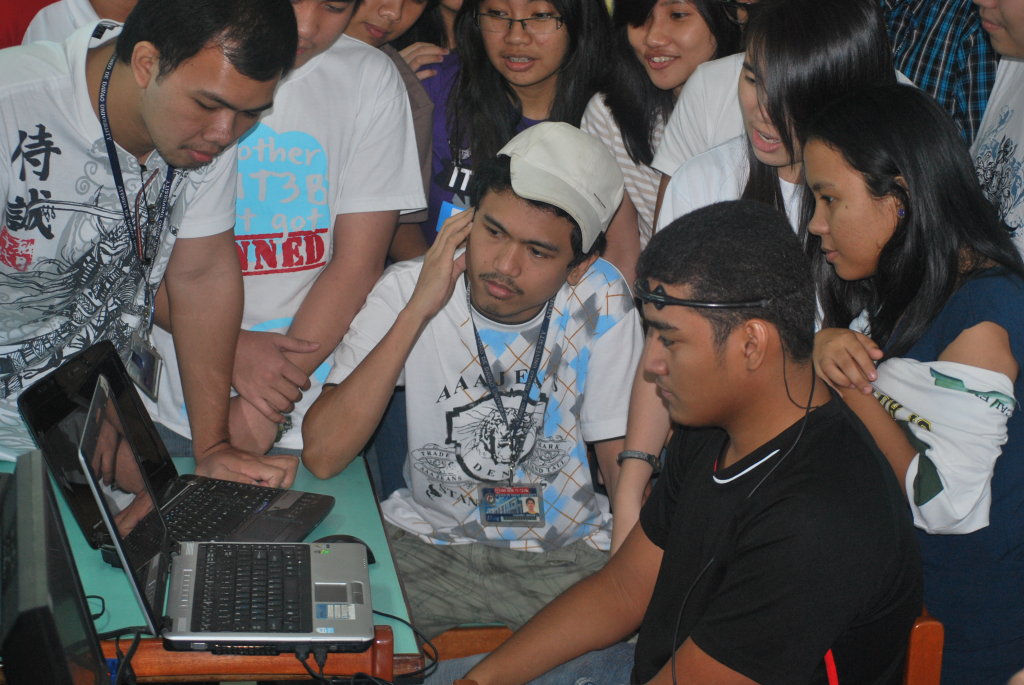
Alternative Classroom Learning Experience (ACLE) 2016 is an annual event headed by the University Student Council (USC) which encourages students to exercise their academic freedom through accessing alternative learning. Eric Vidal gave a talk on Mixed Reality, while accompanied by Renard Calalang, Hannah Tee, and Milky Borbon.

ACLE held last October 12, 2016 at the P&G Room, College of Engineering. Gotta Catch Us All: An ACLE on Mixed Reality and Implications of Pokemon GO.

Posted in News & Events | Leave a comment

ALLS Gets 2 Papers into VRCAI 2016

The 15th ACM SIGGRAPH International Conference on Virtual-Reality Continuum and its Applications in Industry (VRCAI 2016) will be held on 3-4 December 2016 in Zhuhai,China. This year, the conference will take place just before SIGGRAPH Asia 2016, which will be held on 5-8 December in Macao. State-of-the-art technologies and innovative applications in the Virtual Reality Continuum (VRC) will be explored and presented. Spanning across next-generation info communication environments like Virtual Reality (VR), Augmented Virtuality (AV), Augmented Reality (AR) and Mixed Reality (MR), VRC is key in the way we define and interact, with and within, our virtual and physical worlds.

Below is the complete ALLS VRCAI 2016 lineup

  • MAGIS: Mobile Augmented-Reality Games for Instructional Support, by Eric Cesar Jr. E. Vidal, Jayzon F. Ty, Nicko R. Caluya and Ma. Mercedes T. Rodrigo [pdf]
  • Migration and Evaluation of a Framework for Developing Embodied Cognition Learning Games, by Jonathan Casano, Hannah Tee, Jenilyn Agapito, Ivon Arroyo and Ma. Mercedes Rodrigo [pdf]

Congratulations to Eric Vidal, Jayzon Ty, Nicko Reginio Caluya, Neithan Casano, Hannah Tee, Jen Agapito, and Ivon Arroyo!


Posted in Papers | Leave a comment

ALLS Lecture Series October 2016

The ALLS Lecture Series
Monday, 24 October 2016, 3:00 to 4:30, Faura 206
ADMISSION IS FREE

The talks presented during this lecture series represent current research of the Ateneo Laboratory for the Learning Sciences. The October 24 talks will feature brief presentations from PhD Computer Science and MS Computer Science students who are close to defending their proposals.

AN INVESTIGATION OF THE IMPACT OF GAMIFICATION ON NOVICE PROGRAMMERS’ ACHIVEMENT AND LEARNING EXPERIENCE
Jen Agapito
Gamification is becoming a popular classroom intervention used in computer science instruction, including CS1, the first course computer science students take. It is being operationalized as a medium to encourage certain student behaviors in anticipation of positive effects on learning experience and achievement. However, existing studies have mostly implemented reward-based game elements which have resulted to contrasting behaviors among the students. Meaningful gamification, defined as the use of game design elements to encourage users build internal motivation to behave in a certain way, is contended to be a more effective approach. This research focuses on the exploration of how a pedagogical tool founded on meaningful gamification will affect the achievement and learning experience of novice programmers. It will also explore how different user types, as characterized by the Gamification User Types Hexad, vary in their response to different game design elements. It seeks to contribute an empirical investigation of the impact of gamification to novice programmers’ achievement and learning experience.

DESIGNING UX AND UI FOR PERCEIVED CREDIBILITY OF GOVERNMENT WEBSITES
Zarah Elizabeth Arcega
The Philippine administration is making an effort towards the strengthening of e-government in the country so as to adapt to today’s digital landscape. Among their initiatives is the creation of government websites for their various offices. It has been identified that website credibility is perceived by users primarily through visual appeal and navigability. UX and UI design, however, are not as implemented on these kind of websites despite their importance. With that, this study aims to evaluate the perceived credibility of Philippine government websites currently deployed online, create reconfigured versions based on existing models and principles to compare them with, then derive specific guidelines which may be applied in the design and development of such websites.

LEVERAGING AN EXISTING COURSE MANAGEMENT SYTEMS FOR ALTERNATIVE LEARNING
Mikaela Malit
Various learning institutions have made use of learning managements systems (LMS) to support traditional classroom-based courses. This study aims to investigate the effectiveness of introducing Moodle as a supplement to the occasional lessons offered in the Alternative Learning System (ALS) program of the Department of Education. The LMS intends to help ALS teachers manage students and resources as well as contribute to the improvement of student performance by enabling online access to ALS modules, delivery of real-time feedback through quizzes, and monitoring of student profiles. A dynamic quiz generation plugin will also be developed and installed in Moodle to aid ALS teachers in creating quiz content using PDF files. Effectiveness of the LMS will be determined through usability and user acceptance tests, student scores in post-tests and pre-tests, and feedback of ALS management.

AN INVESTIGATION OF THE EINSTELLUNG EFFECT AMONG NOVICE AND INTERMEDIATE PROGRAMMERS
Jun Rangie Obispo
Einstellung effect (EE) is a phenomenon that refers to an individual’s bias towards a familiar, working solution to solve other problems even though more appropriate solutions are available. In the context of programming, the Einstellung effect poses some problems because programmers utilize only solutions they are comfortable with, or approaches they know. This study investigates EE among novice and intermediate programmers when they solve a series of programming problems with similar nature. We look into their plan structures to see resemblances of how they compose plans in solving the programming problems. This study also investigates some mechanisms to address this problem in fixatedness.

THE CREATION OF A GAME SIMULATING AUTISM SPECTRUM DISORDER TO INDUCE EMPATHY IN NEUROTYPICAL PLAYERS
Hannah Tee
Despite autism spectrum disorder (ASD) in approximately 1-2% of the world’s population, people with ASD are greatly stigmatized, leading to an overall lower quality of life. In order to address this, empathy must be induced in non-autistic, neurotypical people. As such, the aim of this study is to create a game which would allow neurotypical players to experience how it is to have ASD. In doing this, the following questions will be answered: (1) Which aspects of autism spectrum disorder can be effectively gamified? (2) Which game elements best simulate aspects of autism spectrum disorder? (3) Which game elements best induce empathy towards ASD in neurotypical players? (4) To what extent is a game effective in inducing empathy in neurotypical players? And (5) Would neurotypical players respond more positively towards specific cases of autism or generalized cases? If so, by how much?

For this study, clinicians and people with ASD will be interviewed to determine which aspects of ASD should be included in the game to convey to neurotypical players, after which a game with 3 levels will be developed on Unity 5.4.x. The game will then be played and evaluated by 10 experts (5 clinicians and 5 people with ASD) and 20 neurotypical players through questionnaires. The experts will evaluate the extent to which aspects of ASD were simulated. Meanwhile, the 20 neurotypical players will be split into 2 groups: a “general playthrough” group and a “specific case playthrough” group. Both groups will indicate which game elements they found most inducive of empathy. The questionnaire will also measure the players’ empathy towards ASD, and will compare the measures of the 2 groups to determine if the specification of cases has any affect on empathy.

To register, click here.


Posted in News & Events | Leave a comment

Call for Papers: WCTP 2016

6th Workshop on Computation: Theory and Practice (WCTP-2016)
September 21-22, 2016, Cebu City, Philippines &
WCTP 2016 Bohol Satellite Workshop
September 23, 2016, Holy Name University, Bohol, Philippines

¨The best theory is inspired by practice. The best practice is inspired by theory.” – Donald Knuth

Workshop Overview
Computation should be a blend of theory and practice. Researchers in the field should create algorithms to address real problems putting equal weight to analysis and implementation. Experimentation and simulation can be viewed as yielding to refined theories or improved applications. This series of workshop started in 2011 organized by De La Salle University-Manila, University of the Philippines-Diliman, Osaka University, and Tokyo Institute of Technology that is devoted to theoretical and practical approaches to computation. It aims to present the latest developments by theoreticians and practitioners in academe and industry working to address computational problems that can directly impact the way we live in society.

Topics
The WCTP 2016 program will consist of invited talks by prominent researchers and contributed talks from submitted papers selected by the Program Committee. All sessions will be devoted to original research. Major topics of the workshop include, but are not limited to, the followings:

Category 1: Theoretical Approaches to Computation
o    Logical approach to software and hardware verification: model checking, theorem proving, etc.
o    Formal approaches to computation: typed and untyped lambda calculi, process calculi, object calculi, etc.
o    Formal frameworks for bioinformatics: P system, ambient calculus, petri nets, etc.

Category 2: Practical Approaches to Computation
o    User modeling (emotion, mood, intention, motion, posture and gesture)
o    User behavior and/or activity modeling
o    Social signal processing
o    Ambient intelligence
o    Intelligent user interfaces

Category 3: Computation for Real World Applications
o    Information Technology in Education
o    Information Technology in Medical Field

Workshop Co-chairs
Hirofumi Hinode
Director, Phil. Office
Cntr Tokyo Institute of Tech.

Masayuki Numao
Director, Int’l Collab.
ISIR, Osaka University

Submission
Submissions related to the topics of the workshop are very much welcome. Submissions that relate results from other areas to the workshop topics are also encouraged. Submitted papers should preferably be typeset in LaTeX2e using the style file. We recommend the usual page limits of around 12 pages.

Any submission should include the session name, the title of the paper, names and affiliations of authors, an abstract of 70-150 words, and the contact author’s name, phone number, fax number, and email address. Submissions must be in English. The paper must be unpublished and not submitted for publication elsewhere, including journals and proceedings of other symposia or workshops. One author of each accepted paper should be able to present it at the workshop.

All submissions should be in PDF file format and uploaded via the Easychair Conference System: https://easychair.org/conferences/?conf=wctp2016

LaTeX macro files and Microsoft Word’s template files are available in the following website.

readme(LaTeX)instrunctions(LaTeX)downloads(LaTeX)readme(Word)instrunctions(Word)downloads(Word)

http://www.worldscientific.com/page/authors/proceedings-stylefiles

Please choose 9″X 6” (For Proceedings Contributors).

Important Dates
August 18, 2016:           Abstract Submission deadline
August 25, 2016:          Full Paper submission deadline
September 3, 2016:        Notification of acceptance
September 12, 2016:      Camera-ready paper deadline
September 21-22, 2016: Technical presentations
September 23, 2016:       Bohol Satellite Workshop

CONTACT INFORMATION
http://www.ttop.ipo.titech.ac.jp/wctp2016/cfp.html

Program Co-chairs
Jaime Caro, University of the Philippines-Diliman
Shinya Nishizaki, Tokyo Institute of Technology
Masayuki Numao, Osaka University
Merlin Suarez, De La Salle University-Manila

Organization Chair
Robert Roxas, Univ. of the Philippines Cebu
email robert.roxas@up.edu.ph


Posted in News & Events, Uncategorized | Leave a comment